
Who Owns the Moment of Play: The Race for Game Data in AI
Game data is becoming fuel for AI. The value goes to whoever captures it. Türkiye produces globally significant gaming data, but captures little of the AI value created from it.

Game data is becoming fuel for AI. The value goes to whoever captures it. Türkiye produces globally significant gaming data, but captures little of the AI value created from it.
A $6.2 billion company built on game clips
In October 2025, a spin-out of a gaming clip app raised a $133.7M seed round. Eleven months later, on 29 September 2026, the same company, General Intuition, closed $220M at a $6.2B valuation. It does not make games. Its asset is what players leave behind: billions of clips from Medal, each one recording what the player saw, which button they pressed, and when.
That pairing of seeing and doing is scarce. Bessemer estimates the world holds roughly 300,000 hours of robot manipulation data, against about 1 billion hours of internet video. Video shows what happens, but rarely which action caused it. Games record both, on every frame, for millions of players a day. And as public text runs out, which Epoch AI expects between 2026 and 2032, play becomes one of the few large, fresh records of human behaviour left for AI to learn from.
Our view is simple. The value of game data does not go to whoever holds the most of it. It goes to whoever controls the point where play is captured, labelled and consented. Türkiye produces some of the deepest mobile game data in the world, but almost none of that layer. This piece is about why that gap matters, and what kind of companies could close it.
What counts as game data
“Game data” is not one thing. It is five streams, held by different owners and useful for different models. The rarest is the first: inputs logged against frames. The one already making money is the third: behaviour and spending.
Each stream carries its own limits. Video is plentiful but unlabelled. Behaviour data is personal data. Chat and voice are the most sensitive of all, because many players are children.
Where game data can go
The upside reaches far beyond games. Every day, millions of people make decisions under pressure, navigate unfamiliar spaces, solve puzzles and react to each other, and games record all of it. Early projects show where that record can travel:
Robots that learned to move from gamers. General Intuition steered a four-legged robot through an office with a model trained on game clips, adapted with just eight minutes of real robot data.
Self-driving cars tested in generated worlds. Waymo built its driving simulator on Genie 3, a world model from Google DeepMind.
Early signs of disease. Sea Hero Quest collected navigation data from 4.3M players. In 2019 it picked out genetic Alzheimer’s risk that a standard memory test missed.
Science at game speed. Over 4M Borderlands Science players aligned 1M gut-microbe sequences. In half a day they produced five times what an earlier puzzle game gathered in ten years. In EVE Online, 839,199 players labelled blood-cell data, and a model trained on their labels reached 90% accuracy (preprint, October 2025).
Maps for machines. Niantic Spatial is building visual positioning on more than 30B images captured by players.
Games are unusually rich sources of action-labelled behaviour data - but that does not mean game data is automatically transferable to physical-world intelligence. The money that already exists sits inside games. AppLovin, which uses in-game behaviour to decide which ad each player sees, made $5.48B of revenue in 2025 at an 82% adjusted EBITDA margin. Unity’s ad product Vector passed a $1B annual run rate in Q2 2026. In a 300,000-player experiment, making levels easier for players about to quit raised ad revenue 21% and in-app purchases by up to 79%.
The frontier money is newer and larger per company. General Intuition has raised about $674M in under a year. Decart raised $300M at about $4B in May 2026 for world models whose early demo was trained on Minecraft play. One market monetises player behaviour today. The other treats that behaviour as training data for tomorrow’s AI systems. Two kinds of money, one logic, which is the subject of the next section.
The capture point
Both kinds of money lead to the same place: the moment play is recorded. AppLovin sold its game studios to Tripledot in June 2025 and still grew revenue 70% that year. Its edge was never the games. It was the software inside thousands of games that sees how players behave. Unity’s Vector crossed $1B as engine data from about 3B monthly players began feeding it.
The frontier repeats the pattern. General Intuition did not buy footage on the open market. It grew out of the app where players record their clips, so every clip arrives with its inputs attached. It raised about $674M. Brokers that resell other studios’ data raised seed rounds: Origin Lab $8M in May 2026 and Worldmodeldata £7M in July, the latter with no contracts or revenue at the time. There is still no public price per hour for gameplay data. One of the few public valuations attached to a gameplay-data asset is the reported ~$500M offer for Medal, which neither side confirmed.
Meanwhile the doors are closing on everyone else. Unity bars training on Unity-derived data without permission. Epic bans training generative AI on its content, and Roblox trains only its own models. Capture without consent is fragile, too: Twitch enrolled all creators in Amazon AI training by default on 12 August 2026 and was sued nine days later.
So owning the capture point means owning three steps: capture, label and consent.
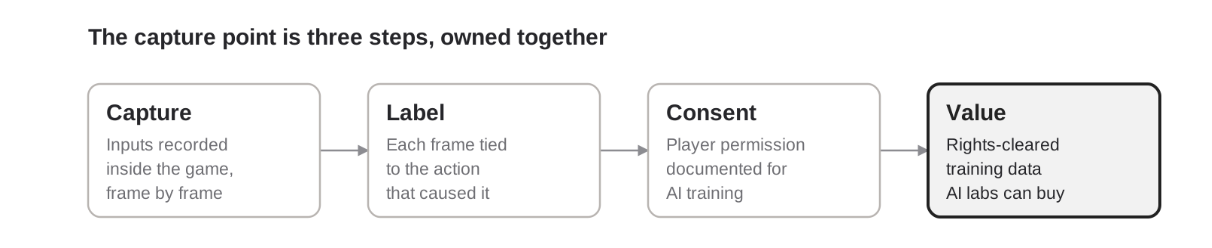
Whoever owns all three owns the value. Whoever owns only the footage owns a cost.
The limits
The value of game data depends not only on volume, but on transferability, rights and consent.
The frontier case is still thin. The robot demo is a single result, and the same robot still clipped chair legs and bumped into bins. NVIDIA left game footage out of its Cosmos world models, citing unrealistic dynamics. Game data appears particularly well suited to navigation, driving and game agents, while its transferability to fine-grained physical manipulation remains less proven.
The legal case is tightening. In Europe, training on personal data under “legitimate interest” requires a documented three-step test, and regulators can order a model retrained. “Anonymised” play is a weak promise: researchers identified VR players with 94% accuracy from 100 seconds of motion. In the US, sharing a child’s data for AI training now needs separate parental consent. Ownership is split too: players own clips, publishers own the game in every frame, platforms hold licences, and no court has yet sorted out how these interact.
The people who make games are wary. At GDC 2026, 52% of developers said generative AI harms the industry, up from 18% in 2024. None of this kills the thesis. It raises the value of capture that is clean, consented and documented, because that is the only kind that will survive.
Türkiye: deep data, missing layer
Türkiye already won the game. Turkish developers earned about $2.76B in global mobile revenue in 2025, roughly 5% of the world market, up from 1% in 2020 by AppMagic’s estimate. Downloads fell 4% to 1.8B while revenue rose, so the data is getting deeper per player, not wider. Royal Match alone has about 9.8M daily players. One investor describes the culture as “almost as if Hollywood met a hedge fund”. Loom Games reached a valuation above $1B with about 20 people.
But the data is narrow and much of it no longer sits in Türkiye. Puzzle games make up 96.9% of revenue, and Dream Games and Peak together earn over 80%. Zynga bought Peak, Gram and most of Rollic in 2020. Scopely, owned by Saudi-backed Savvy, took a majority of Loom in February 2026. A substantial share of Turkish-developed mobile revenue is now captured by foreign-owned studios.
The layer between the data and the models is almost empty. AppNava, a Turkish gametech company that predicts how much a player will spend, raised $2.3M in September 2026. Earlier tool companies were sold early to foreign buyers: MobileAction to InMobi, Playable Factory to Tamatem. We found no Turkish studio that publicly trains a foundation model or licenses player data to an AI lab. Türkiye exports games. It does not yet export what is learned from them. The opportunity is therefore not to build another game studio, but to own the layer that turns millions of gameplay decisions into reusable intelligence.
What could come out of Türkiye and its diaspora
Three kinds of company could come out of Türkiye and its diaspora. Each has a clear condition.
1. In-game AI, sold to the world. The most ready opportunity is tools that turn play data into decisions: how much a player will spend, when they will quit, which level or offer to show next. The people who built the data and AI teams inside Dream, Peak, Joygame and Spyke are the natural founders, and the 300,000-player experiment shows what the product is worth to a studio. AppNava is an early example. The condition: local studios open their doors as first customers, and the product is built for global sale from day one.
2. Consented capture and packaging. The capture point needs an owner outside the big platforms: software that records inputs inside games with player consent, labels them, and packages them for AI labs. Origin Lab already does this with 20+ publishers on a revenue share. Turkish studios carry a compliance burden that can become an advantage. Since 1 June 2024, sending Turkish players’ data abroad requires a standard contract notified to the regulator within five business days, and GDPR applies to their players in Europe. A company that solves consent and transfer for its home studios can sell the same answer to studios everywhere. The condition: contract templates studios trust, a fair revenue share, and buyers inside AI labs.
3. Diaspora-led simulation and data companies. Türkiye will not produce a foundation-model lab on its own; General Intuition raised about $674M in a single year. The realistic model pairs founders who trained in labs abroad with engineering and data teams in Istanbul, building simulation and training data for narrow domains such as warehouses, factories or driving. The condition: a foreign entity, access to large rounds, and real ties to the labs that buy.
The capital bridge already exists. a16z and Point72 joined TaleMonster’s $30M Series A, built by an ex-Peak team. General Catalyst led Mission Control Games’ $4M pre-seed, founded by former Gram developers. Arcadia, a London-registered $100M gaming fund led by Akın Babayiğit, has started backing the tooling layer too, with a round in the AI-native engine Kantrip. Global money already trusts Turkish game teams. The open question is whether it will follow them from games into data.
What needs to happen
For these companies to exist, five things have to change:
Studios treat play data as an asset, not exhaust. That means building consent into the moment of capture and opening pilots to local tool companies.
Data teams spin out. The people who built churn, value and difficulty models inside the big studios are the most credible founders of the layer.
Founders build for the world from day one. The first customer can be in Istanbul; the market is every studio and every AI lab.
Investors need to fund the layer early enough for companies to remain independent long enough to become platforms. MobileAction and Playable Factory were sold to foreign buyers early.
The diaspora closes the loop. Turkish researchers and operators abroad can connect Istanbul teams to the labs that buy data and the funds that write large cheques.
Türkiye already won the game. The next question is who wins what the game teaches.