
Applied AI's New Vertical: The Capital Flow into Physical AI
A view from Boğaziçi Ventures on why robotics and embodied AI deserve a seat at the applied-AI table

Every few years, applied AI grows a new limb. We are now watching it happen again, this time somewhere less familiar and considerably more physical: robotics.
At Boğaziçi Ventures, we think about artificial intelligence in three layers. Foundational AI gives us the frontier models. Infrastructure AI gives us the rails those models run on. Applied AI is where we live — the layer where intelligence meets a real workflow, a real customer, a real P&L. For years, “applied” meant software wrapped around a large language model: a smarter CRM, a faster claims processor, a kinder chatbot. That definition is expanding. Increasingly, the workflow AI is being applied to has a body — an arm, a leg, a warehouse floor to cross. We call this physical AI, and the capital markets have already decided it is not a niche.
The numbers behind the shift
The scale of the reallocation is hard to overstate. PitchBook's most recent Robotics & Physical AI report counted a record $27.6 billion invested across 1,009 deals in 2025 — more than double the $13.7 billion committed in 2024. The momentum did not pause into the new year: Q1 2026 alone brought an estimated $16.3 billion across 492 deals, the strongest quarter the category has ever recorded. Crunchbase's narrower count tells the same story from a different angle — nearly $14 billion in 2025, already eclipsed by roughly $18.8 billion in the first half of 2026.
Numbers like these rarely move without a reason, and this one is not hard to find. Robotics has spent decades as a hardware problem with a software afterthought — expensive to build, expensive to program, and painfully brittle outside a small number of pre-mapped tasks. What changed is not the hardware. It is the software wrapped around it. The same generative techniques that gave us fluent chatbots are now being trained on movement instead of language, and the earliest results are good enough that some of the world's most disciplined investors are treating robotics less like industrial automation and more like frontier AI.
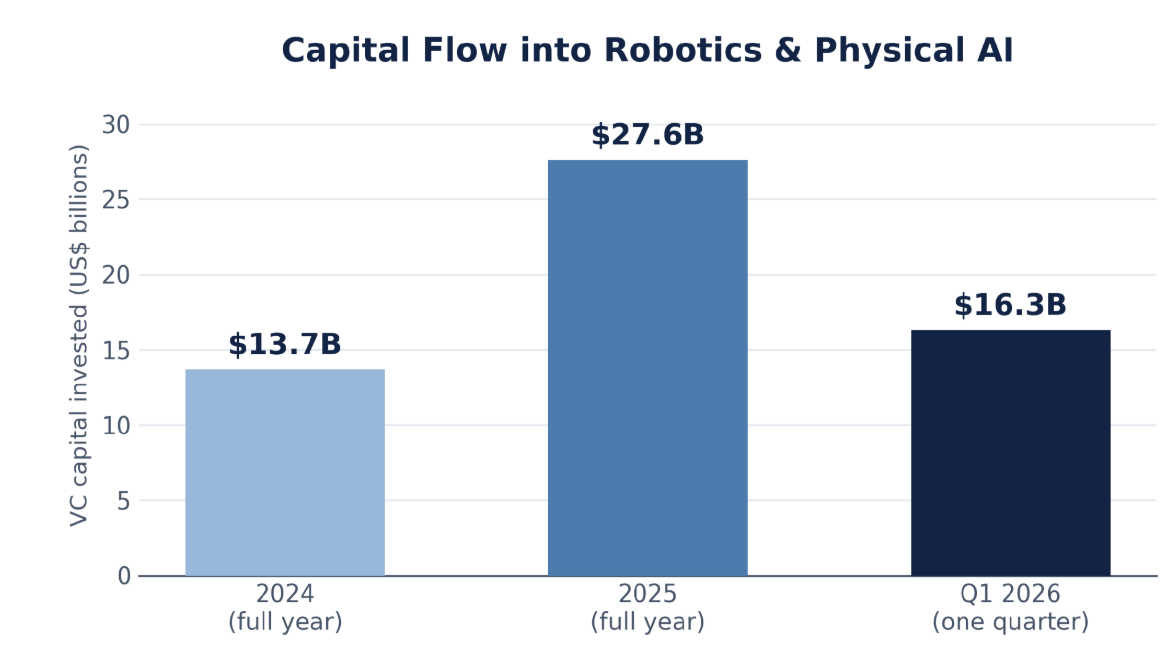 Source: Pitchbook Robotics & Physical AI reports; Crunchbase.
Two archetypes: brains and bodies
If you look closely at where the capital is landing, it clusters into two distinct bets.
The first is the humanoid hardware maker — companies building the body. Figure AI closed more than a billion dollars in committed Series C capital in September 2025 at a $39 billion valuation, a fifteen-fold step-up from where it stood eighteen months earlier, with backers ranging from Brookfield to NVIDIA to Qualcomm Ventures. Its Figure 03 robot, unveiled weeks later, is already running shifts alongside people at a BMW plant in South Carolina. Apptronik followed a similar arc, extending its Series A to more than $935 million in February 2026 at a valuation above $5.5 billion, with its Apollo robot in active trials with Mercedes-Benz and GXO Logistics.
The second bet is on the brain rather than the body — hardware-agnostic foundation models that aim to control any robot regardless of its shape. Physical Intelligence, co-founded by researchers out of Google DeepMind, UC Berkeley, and Stanford, raised $600 million in November 2025 at a $5.6 billion valuation on the strength of its π-series models, which fold laundry and bus tables today and are reportedly already earning revenue in a San Francisco laundromat. Skild AI went further and faster: a $1.4 billion round in January 2026 tripled its valuation to over $14 billion in just seven months, on the back of an “omni-bodied” brain the company says has already generated meaningful commercial revenue deploying on security, warehouse, and manufacturing robots — including, notably, on a Foxconn production line running NVIDIA's newest chips.
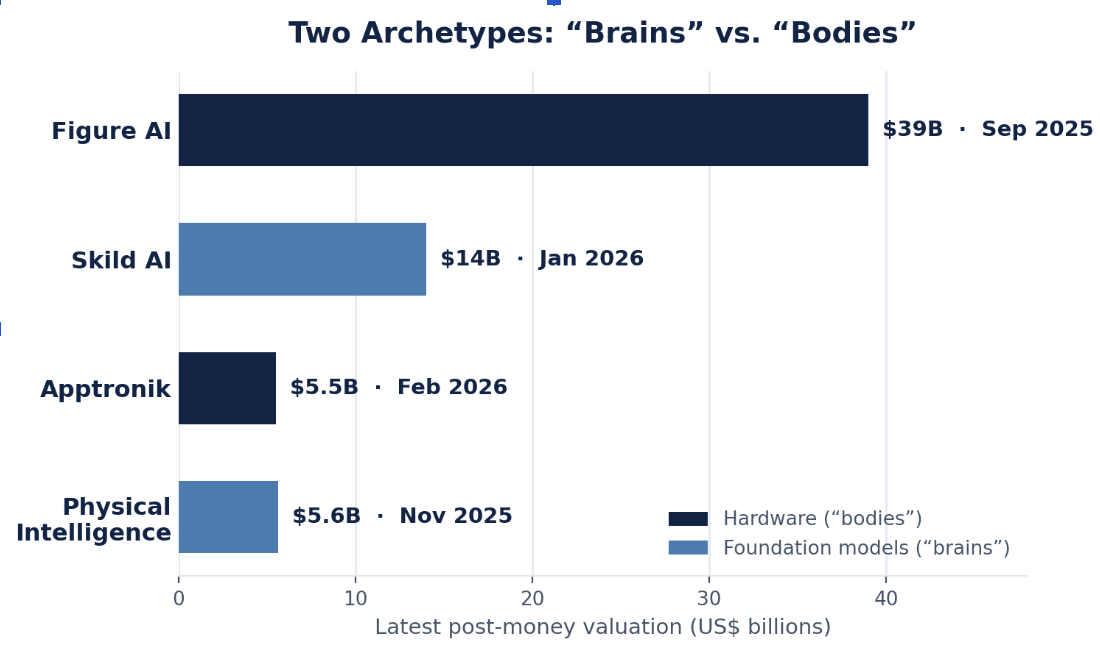
Post-money valuations at most recent disclosed round; see named rounds above for dates and lead investors.
It is a useful reminder that this wave, unlike the last one, cannot be won with a browser tab and a GPU cluster alone. It needs steel, motors, and a factory floor. That is precisely what makes it interesting to us as investors who have spent our careers in emerging markets that build things.
That claim is not rhetorical. Türkiye produced 1.42 million vehicles in 2025 — enough to rank as the world's thirteenth-largest automotive manufacturer and Europe's fifth-largest, exporting roughly three in four of those vehicles into the continent's OEM supply chains. Baykar alone generated $2.2 billion in UAV exports last year, extending its run as the world's largest exporter of armed drones for a third consecutive year, and the country's broader defense and aerospace sector closed 2025 at a record $10.56 billion in exports, more than triple its 2019 level.
Why an applied-AI investor should care, and where to be careful
We have spent enough years underwriting applied AI to know when a category is being mispriced, in either direction, and physical AI is unusually hard to wave off as noise. Jensen Huang has called it the industry's next “ChatGPT moment,” declaring at VivaTech in June 2025 that it had arrived, and pegs the addressable opportunity at roughly $50 trillion across manufacturing, logistics, and autonomous machines. Andreessen Horowitz has stood up a dedicated $600 million fund for “AI for the physical world.” Sequoia's new co-stewards, Alfred Lin and Pat Grady, committed some $10 billion in August 2026 — the largest single bet in the firm's 54-year history — as part of a broader “reindustrialization” thesis reaching into robotics, defense manufacturing, and energy, built on the argument that AI models are only as valuable as the physical infrastructure they can act on. Morgan Stanley's analysts, not known for whimsy, model a roughly 5-trillion-dollar humanoid hardware-and-services economy by 2050. When this many of the most disciplined allocators in the industry converge on the same thesis inside an 18-month window, the interesting question is no longer whether to pay attention. It is how to underwrite the category without getting swept up in it.
That means being honest about the gap between valuation and reality. Figure's own CEO Brett Adcock told TIME in 2025 that full autonomous operation in the home is something the company thinks it “can get to in 2026, but it's a big push” — not a certainty. Independent reporting found that many of 1X's celebrated home-robot demonstrations were, in late 2025, still operated by a human in a VR headset rather than by the robot itself. Tesla shipped a small fraction of its 2025 Optimus production target and has never published an official count. None of this is a reason to dismiss the category — every transformative technology looks unfinished up close. It is a reason to hold it to the same standard we hold any applied-AI company to: a deployed workflow, a paying customer, and a defensible answer to why an incumbent cannot simply copy it within a year. A robot does not get a pass on unit economics just because the demo video is impressive.
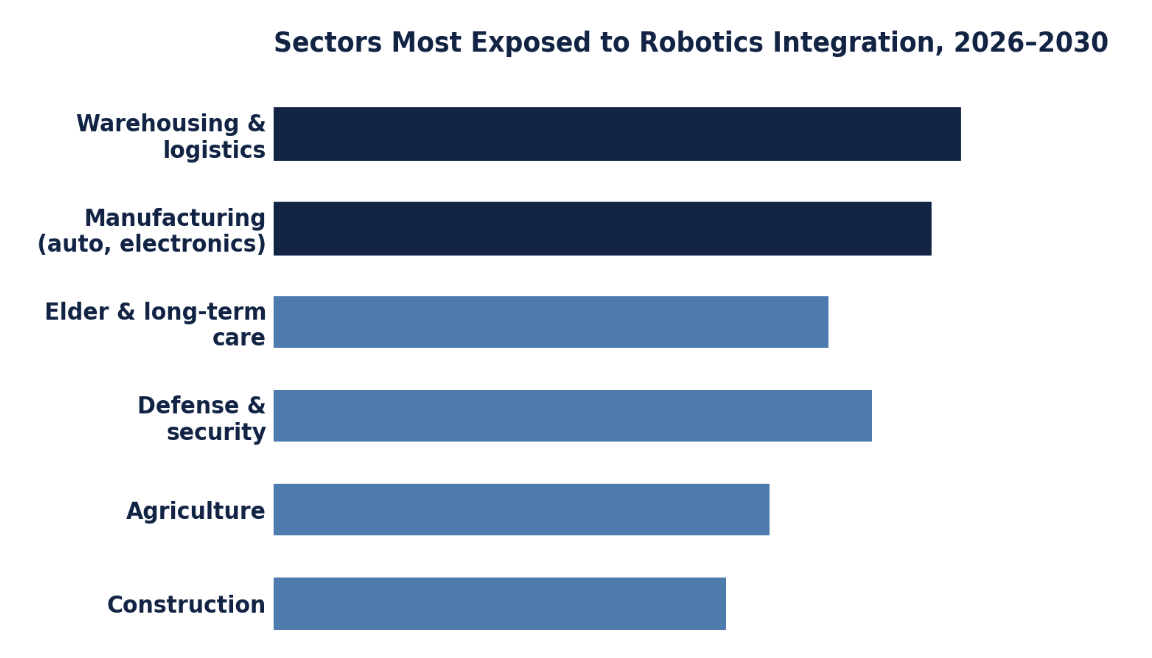
Illustrative ranking by Boğaziçi Ventures based on deployment pace, capital inflows, and labor-shortage pressure — not a market-sizing index.
The sectors most exposed to this wave are not evenly distributed. Warehousing and logistics remain the largest near-term deployment surface — Amazon alone already runs on the order of three-quarters of a million robots across its fulfillment network — followed closely by manufacturing, where BMW, Foxconn, and Mercedes-Benz are already running humanoid pilots on live production lines. A less obvious but arguably more durable driver is elder and long-term care. South Korea became a “super-aged” society in 2024, with more than one in five citizens now over 65, and Japan crossed that threshold years earlier; both governments have made care-robot procurement an explicit national priority, and the global elder-care robotics market — valued at roughly $3.1 billion in 2025 — is forecast to more than triple by the early 2030s.
Mapping the stack, and what comes next
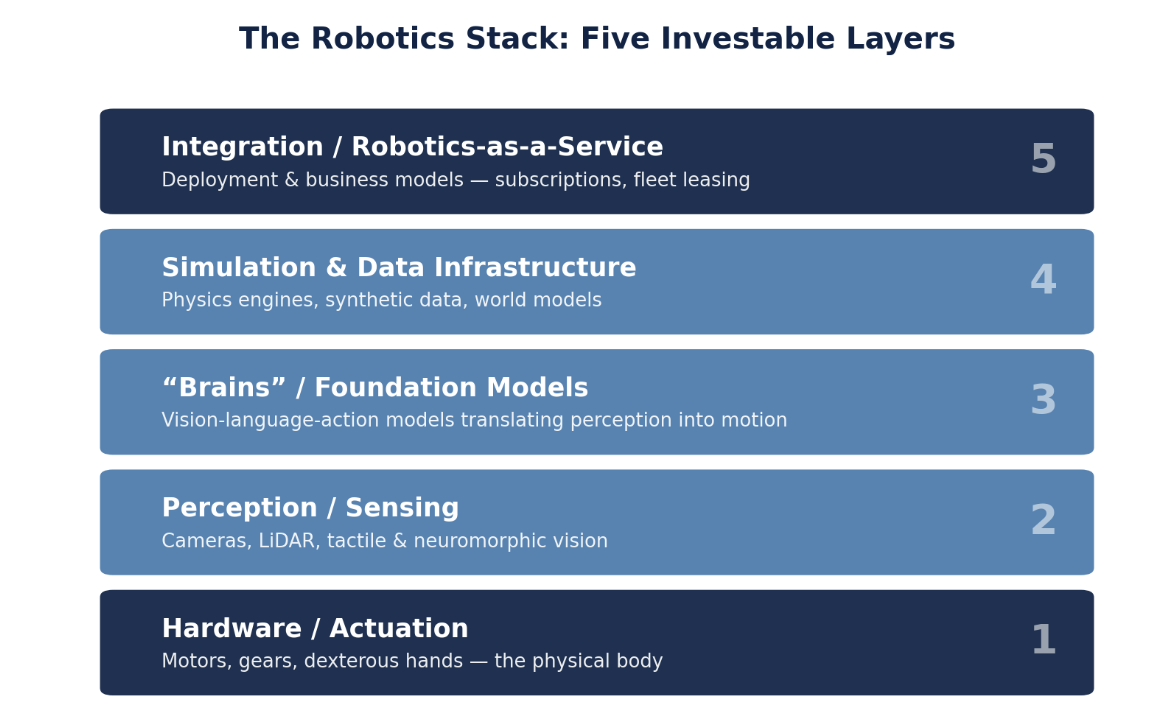
Robotics is not one investable thing; it is at least five. There is the hardware and actuation layer — the motors, gears, and hands that give a robot its body, a supply chain where Chinese manufacturers now build roughly nine in ten humanoids sold worldwide. There is the perception layer — the cameras and sensors that let a robot see, where a new category called neuromorphic, event-based vision is quietly solving the latency and power problems that held earlier robots back. There is the brain layer we described above — the foundation models translating perception and language into motion. There is the simulation and data layer, arguably the least visible and most important: because there is no “internet of robotics” to pretrain on, companies are building physics engines and synthetic-data pipelines to manufacture the training data that does not otherwise exist. And finally there is the integration layer — the robotics-as-a-service business models that let a customer pay a monthly fee for a working robot instead of a capital-intensive purchase, lowering the barrier to the first real deployment.
This is also why, within BV Portföy, robotics is organized as its own thematic fund rather than folded into a generalist mandate. The underwriting questions, the cap tables, the hardware cycles, and the exit timelines look different enough across these five layers that treating robotics as a single category would flatten distinctions we think investors need to price correctly. It is a structure that reflects conviction, not a side bet: we would rather build focused expertise in a category we believe is becoming a durable vertical than approach it opportunistically, one deal at a time.
Over the coming weeks, we intend to walk through several of these layers in more depth through BV Growth II Applied-AI fund — starting with perception, and with a question close to home: what role Türkiye's defense and drone ecosystem, and the wider Türkiye–Korea corridor we know well, might play as this stack takes shape outside Silicon Valley.
A note to founders
If you are a founder building anywhere in this stack, we would like to hear from you — and we say that with a specific kind of encouragement in mind. This is not a category where Turkish teams are spectators. In just the past few weeks, we have seen a Turkish-founded robotics “brain” startup earn a place in Y Combinator's most recent batch, days after being founded. It is an early, modest data point next to the headline valuations above — but it is exactly the kind of data point that tells us where to look next.
We do not need you to have solved general-purpose robotics. We need you to have found one physical workflow — in a warehouse, a farm, a factory, a fleet of drones — that is tedious, dangerous, or simply too expensive to keep doing by hand, and a credible plan for teaching a machine to do it. That is applied AI in its oldest and truest sense. It just happens, this time, to have a body.