
Voice AI: Where the Value Moved After Speech Models Went Open
The product development cycle in AI is shortening rapidly. A capability released in one quarter becomes an ordinary feature in the next. Voice is the clearest example of this compression so far. The models that let a machine listen and speak did not merely get cheaper. They became downloadable.
The product development cycle in AI is shortening rapidly. A capability released in one quarter becomes an ordinary feature in the next. Voice is the clearest example of this compression so far. The models that let a machine listen and speak did not merely get cheaper. They became downloadable.
Why this matters: when something goes wrong, when an appointment needs booking, or when a customer wants an answer now, most of the economy still runs on the phone. A model that can sustain that call is a capability. A product that can close that call inside the customer's own systems and under the rules of the customer's own sector is a company. The shift is not limited to the phone either. Many product experiences that were previously delivered through text or a screen can now be redesigned around natural, real-time conversation.
In 2026 the distance between the two opened wide enough, and attracted enough funding, to be looked at as a market. This article examines where the value went once the model stopped being scarce.
The Model Layer Went Open
OpenAI released its Whisper speech recognition model as open source on 21 September 2022. At the time this was an exception. Four years later it has become the rule.
Sesame opened CSM-1B, the model behind its viral assistant Maya, under an Apache 2.0 licence in March 2025. NVIDIA released Nemotron 3.5 Transcribe on 28 October 2026: an open-weight model with 34 billion parameters, roughly 4 billion of them active per step, that transcribes 40 languages, translates 31 of them into English, and permits commercial use. It ranks first among open models on Hugging Face's English speech recognition leaderboard with an average word error rate of 5.33 percent. Its training data, Granary v2, contains 463,062 hours of speech across 48 languages, and that too is open.
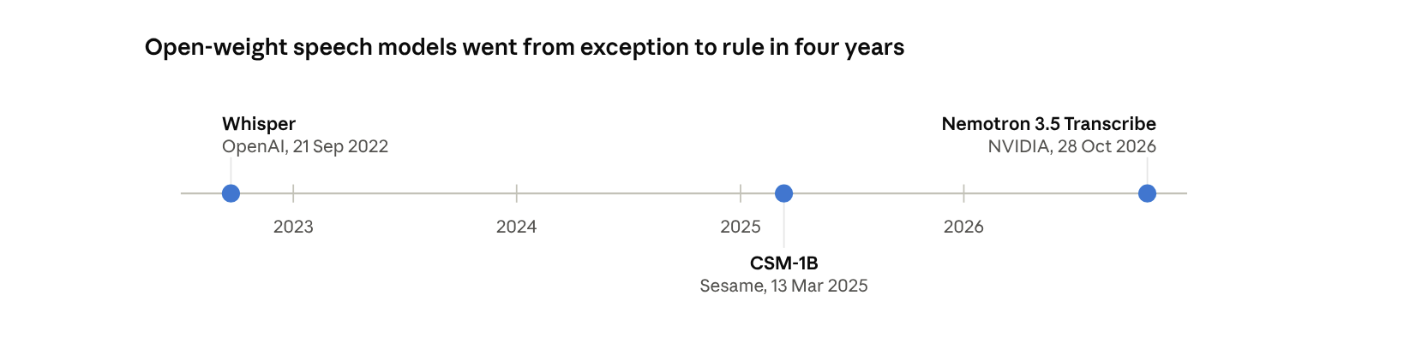
E1 · OpenAI, Sesame and NVIDIA announcements · open-weight release dates
The makers of these models are not narrow niche players. The market's largest hardware supplier and its largest model laboratory are deliberately commoditising the speech layer. This is a strategy: the cheaper the model, the larger the volume of applications running on top of it, and that volume flows back to hardware and APIs.
Price has moved in the same direction. Cartesia's hosted voice agent product costs 0.03 USD per minute as of November 2026, with the previous price of 0.06 USD struck through on the company's own pricing page. AssemblyAI launched its first TTS model on 27 October 2026 at 15 USD per million characters. For the speech layer, a minute of a phone call now costs a small fraction of a call centre minute.
Cost is not the only thing falling. As the quality of open models rises, commercial models also offer more natural speech, lower latency and multilingual performance. Competition runs not only on the model getting cheaper but also on user experiences that were previously impossible becoming producible. These two movements produce different outcomes. The fall in cost makes taking over existing phone traffic profitable. The jump in quality opens a new category in which voice itself is the product.
Our interpretation is this: there is no longer a defensible difference a startup can build in this layer. Training a better Turkish ASR model is possible, but it should be assumed to be a feature rather than a company, and one that the next open release will close. Value has to be sought elsewhere, and the next section shows where that is.
Demand Is Real and Measurable
Spending rose as the model got cheaper. Two data points show this from different angles.
Menlo Ventures' enterprise AI report, published on 3 November 2026, rests on a survey that Morning Consult ran between 8 and 26 September 2026 with roughly 400 US enterprise decision makers. According to the report, spending on customer service agents reached 2.7 billion USD and grew 4.3 times in a year. Among the application categories the report tracks, this is the fastest growing item after coding and enterprise chatbots. Sierra and Decagon are named as the category leaders. Sierra raised 950 million USD in May 2026 at a valuation above 15 billion USD.
Menlo's market sizes rest on an estimation model built from the survey, public financial statements and third party reports. For that reason we read the figures as indicators of direction and speed rather than of magnitude.
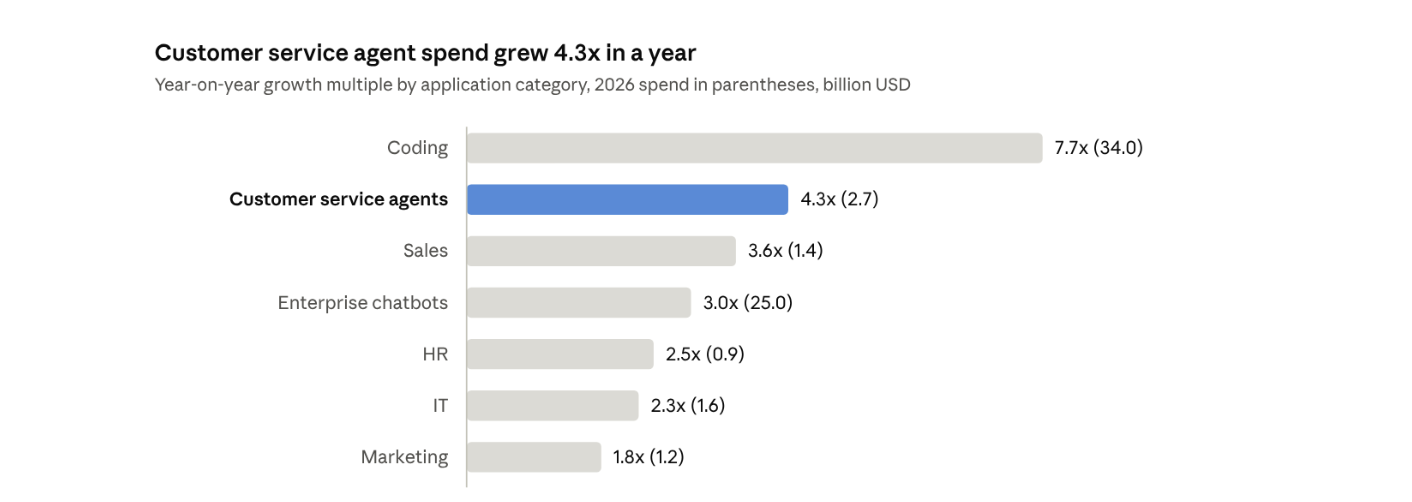
E3 · Menlo Ventures, 2026: The State of Enterprise AI, 3 November 2026 · 7 application categories
The second data point is not an estimate but a balance sheet. Twilio announced that its revenue in the third quarter of 2026 rose 20 percent year on year to 1.56 billion USD. Voice revenue grew more than 20 percent, and self-serve voice revenue grew roughly 55 percent. The company tied its first eight-figure Conversations agreement, signed with a health insurer, to its ConversationRelay product. For a telephony infrastructure company that grew in single digits for years, the voice line becoming the growth engine again is the most concrete sign that agents have started carrying real phone traffic.
Read together, these two data points make the picture clear. The speech model is free, but there is a budget for the call minute run on that model, and it is growing. The question is which kind of company that budget goes to.
Three Categories of Company
Capital in this space is spread across three product types with different economics.
Those Who Sell Voice
These companies sell the voice capability itself: the model, real-time transport, the agent framework. ElevenLabs closed a 500 million USD Series D in February 2026, led by Sequoia, at an 11 billion USD valuation. Deepgram announced on 29 October 2026 that it is acquiring Daily, the developer of the open source voice agent framework Pipecat, and moved Pipecat to an independent foundation. Cartesia halved the price of its hosted agent product the same week.
These three moves say the same thing. The infrastructure layer is consolidating, entering price competition, and using the open source framework as its own distribution channel. There will be winners here, but the capital and scale needed for a new early-stage startup to enter this picture are not within reach of a pre-seed round.
Those Who Close the Call
These companies do not sell voice. They take over a sector's phone line. On 28 October 2026 Broccoli announced its Series A and Series B together, a total of 52 million USD led by Khosla Ventures. The product answers the phones of plumbing, HVAC and electrical businesses, books appointments, follows up on estimates and renews service memberships. By the company's own account it has more than 1,500 business customers, has handled more than 10 million conversations and has booked 2.5 million appointments. These figures come from the company and have no independent verification.
The same pattern appears in other sectors: agents that reach borrowers in consumer lending, appointment lines in clinics, carrier conversations in logistics. In each, the product connects to that sector's scheduling software, its CRM and its payment system, and every call is closed inside those connections.
Those for Whom Voice Is the Product
In the third type, voice is not an interface that automates an existing workflow but the core experience of the product. Language learning, education, interactive content and personal assistants fall into this group. Here the competitive advantage forms less in the voice model than in the product design, personalisation and user engagement that turn conversation into measurable value for the user.
Our portfolio company Lucida AI is an example of this type. The product is a voice language coach that listens to the user's speech in real time, gives feedback on pronunciation, fluency and grammar, and personalises the lesson by remembering past conversations. According to the figures the company shared when it announced its seed round in April 2026, the product reached more than 3 million users in nine months, with 45 percent of users in Europe and 44 percent in the US. According to the update it shared in November 2026, it closed 2025, its first year, at 4.8 million USD ARR and is at roughly 15 million USD ARR in 2026, a threefold growth in one year. These figures are company statements. The round was the first investment of the BV Growth II fund.
New speech models are a direct opportunity for this type. More natural, lower latency conversation that follows context better directly raises the quality of a voice language learning product. But the investor question is not how well the model speaks. Is the user talking longer and more often, does the conversational experience measurably improve the learning outcome, can the model remember the user's level and past mistakes and build a personalised flow, and as new models lower the cost per user, are retention and LTV rising. The defensible advantage is not owning the voice model but the pedagogical system, the user context and the distribution power that turn conversation into a learning outcome.
This distinction matters for underwriting. The first type sells a capability and competes with everyone who sells a platform. The second type replaces a budget line that already exists, namely the cost of calls that go unanswered or are answered late. The sales cycle is shorter, and the product is harder for a platform to bundle away. Because what is sold is not a feature but an outcome. In the third type, value comes from voice interaction creating an experience the user will not give up. For that reason the thesis that value moved to whoever closes the call is correct but incomplete on its own. Value is also moving to applications in which voice itself is the product.
Which Layer Stays With Whom
The voice agent is not a single product category. Platform owners have released their own agent layers.
OpenAI's Realtime API and Google's Gemini Live come from the model side. Salesforce's Agentforce Voice and Twilio's ConversationRelay come from the CRM and telephony infrastructure side. Southern Cross Credit Union in Australia built an agent on Agentforce Voice in six weeks that answers account balance queries, and according to Salesforce's case study the agent handles 7 percent of all calls. The agent was built with Salesforce's forward deployed engineers. This shows that a voice agent can be placed on top of a platform the customer already uses in six weeks.
Our reading is this: a significant part of general-purpose voice infrastructure will be provided by the large platforms. A balance query inside a CRM, or an IVR replacement inside a telephony infrastructure, is a candidate to become a feature of the platform owner's own product. However, the product layers of OpenAI, Google, Salesforce and Twilio differ from one another, and none of them will cover every use case at the same speed. These platforms should not be expected to develop in depth the workflows specific to every sector and every user experience. The growth of sector-focused voice companies is the result of this gap: what Broccoli does in the trades and what Lucida does in language learning are too narrow to enter a platform's roadmap.
The layer that stays open is the one the platform does not see. A plumbing business's intraday scheduling, a clinic's insurance verification, a carrier's load negotiation, a lender's collection rules. In these places the call is closed inside a workflow the platform does not know, and learning that workflow, integrating it and improving it a little with every call is too narrow for the platform owner to invest in and wide enough for a startup to grow in.
The general-purpose layer belongs largely to the platforms, the sector-specific and experience-specific layer is open. Pricing this distinction before an investment is cheaper than pricing it after.
From an Investor's Perspective
These dynamics require an investor evaluating voice agent companies to look beyond the quality of the demo. Every agent now speaks well. The question is whether it can close the call.
What to measure depends on the product type. For vertical voice agents, the things to look at are what share of calls is closed without handoff to a human, what the cost per closed call is, what gross margin per minute remains after model and telephony costs, and how much shorter integration for the second and tenth customer was than for the first. For consumer applications in which voice is the product, these metrics are meaningless. There the things to look at are D7 and D30 retention, conversation frequency and length, a measurable learning or usage outcome, inference cost per user, and LTV/CAC. In both groups, if these metrics are absent the product is still a pilot.
Evidence quality requires the same rigour. Most of the figures circulating in this category were produced by the company selling the product. The claim that a collections agent reaches borrowers more often than a human team, or that a model reaches first audio in half a second, is sales material unless verified by a customer reference. Customer references are more informative than research citations.
The cost of unmeasured automation has also been documented. In May 2025 Klarna announced that it had started hiring human representatives in customer service again. In the words of CEO Sebastian Siemiatkowski, the priority on cost had lowered quality. The lesson is not that the agent did not work, but that which calls are left to the agent is a product decision.
On the regulatory side, risk and clarity arrive together. In the US, the FCC ruled in February 2024 that AI-generated voice calls require consent under the TCPA, and with its order of 1 October 2026 it reorganised the methods for revoking consent, rules that take effect on 25 November 2026. In Europe, Article 50 of the AI Act requires, from 2 August 2026, that every AI system interacting directly with people disclose this clearly. These rules make outbound calling harder and give a structural advantage to products that take on permitted, inbound traffic. An agent that discloses its identity, manages recording consent and processes a revocation request immediately turns the cost of compliance into a product feature.
Valuation should be assessed against the size of the market being contested. Menlo's 2.7 billion USD category estimate is smaller than a single valuation above 15 billion USD. That price assumes the winner will grow the category several times over. At an early stage, a vertical agent does not require the same assumption. A single sector's unanswered calls are large enough to justify a pre-seed round.
What This Means for Türkiye
Open speech models are not equal in every language.
According to Whisper's own paper, 117,000 of the 680,000 hours of audio the model was trained on belong to the 96 languages other than English. In other words, the non-English languages share 17 percent of the total data, and the paper shows that the error rate rises as data per language falls. NVIDIA's Granary v2 dataset covers 48 languages, but the distribution of its 463,000 hours across languages is just as skewed. An agent that works in an English phone call is not as reliable in a Turkish one, especially against regional accents, phone line noise and interrupted speech.
This looks like a model problem but it is a deployment problem. In a world where the model layer is open, what makes the difference for Turkish is not training a new model. It is making the open model work in Turkish phone traffic, with a specific sector's vocabulary, on real calls, and accumulating sector-specific data from every call. This work is too narrow for a global platform to do for Türkiye and wide enough for a startup to build a company on. The opportunity in Türkiye is not only understanding Turkish speech correctly, but developing products that meet the needs of a specific sector or user group through Turkish speech and produce measurable outcomes.
Three areas stand out.
Vertical agents that take over a sector's phone line. Appointments and reminders in healthcare, claims notification in insurance, shipping and returns in e-commerce. Each carries Turkish, high-volume and largely repetitive call traffic.
Permitted inbound in financial services. Banking and collections require call recording, identity verification and consent management. An agent that embeds KVKK compliance inside the product turns the cost of compliance into a sales argument.
The small business phone. The Turkish counterpart of what Broccoli does for plumbing and HVAC in the US: a product that turns the unanswered call into an appointment and connects to the scheduling and payment tools the business uses. Here the customers are many, the contracts are small and the distribution channel is decisive.
The Moat in Voice AI
When the model is free, the moat accumulates in the layers around the model. In the voice agent those layers are clear: integration into the customer's scheduling, CRM and payment systems, knowledge of the sector's call scenarios and their exceptions, and the real conversation data that accumulates from every call and exists in no other dataset. This data closes the next call at a higher rate and embeds the product a little deeper in the customer's operation. In companies where voice is the product, the same loop runs through product data and user engagement. The moat consists not only of conversation data but of the product loop that turns this data into better outcomes. Every interaction should make it possible to understand the user's context better, to personalise the experience, and to raise the value of the next interaction.
The opening of speech models did not shrink this category. It changed who will win. Not the company with the best model, but the one that closes a specific sector's phone most reliably and becomes far harder to copy at the hundredth customer than at the first. When producing voice becomes cheap, the winning companies will not be those that speak best, but those that can turn every conversation into a better outcome. Turkish is not an obstacle in this race. It is the border of a territory the global platforms will not enter.