
Industrial AI: A Hard Vertical with a Strong Moat

The product development cycle in AI is accelerating rapidly. Shortly after a new model is released, numerous products targeting similar use cases can enter the market. Industrial AI, however, remains one of the areas that has largely stayed outside this pace.
The main reason is that AI in industrial settings interacts directly with the physical world. Factories, production lines, energy systems, warehouses, machinery, and engineering processes operate alongside sensors, PLCs, industrial control systems, robots, maintenance records, legacy software, and physical infrastructure that has often been running for decades.
This also significantly raises the cost of failure. A wrong decision can lead to production losses, equipment damage, or even safety risks. This is where the technical and operational barriers facing Industrial AI companies begin. Over time, those same barriers can become a powerful source of moat for the companies that successfully overcome them.
The Market Is Large, the AI Layer Is Still Emerging
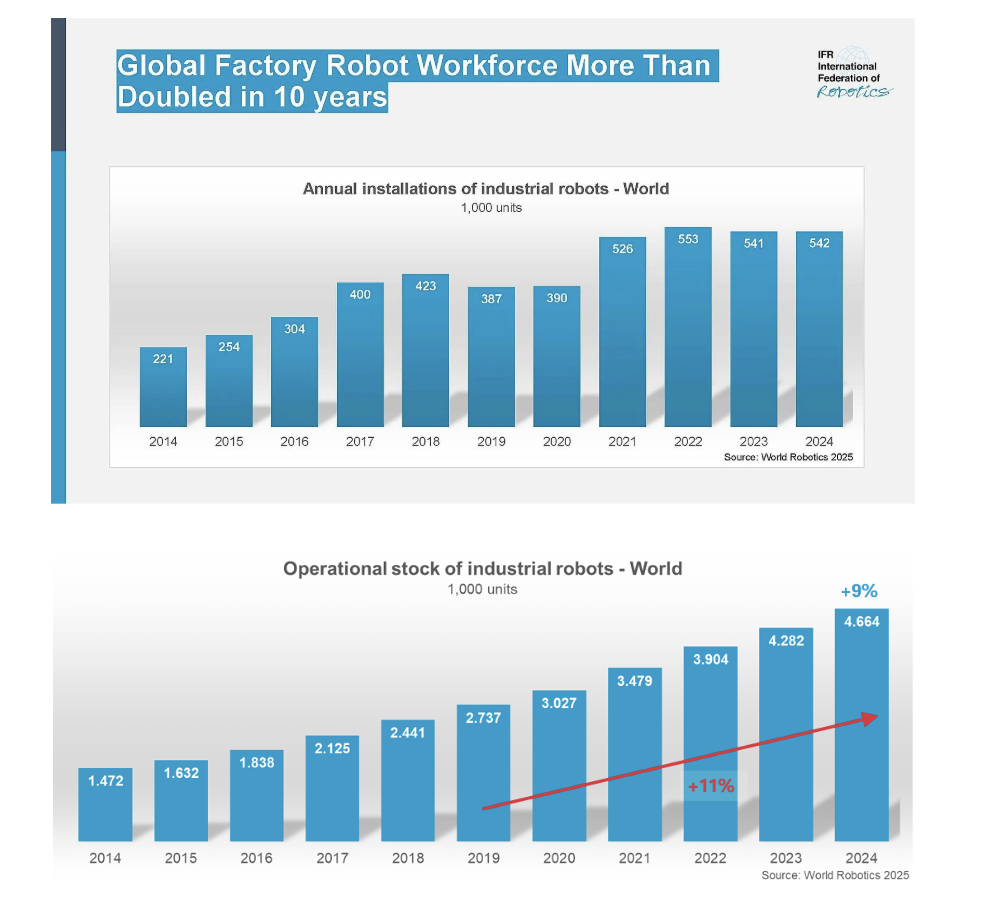
Industrial automation has long been a large-scale market. According to the International Federation of Robotics, 542,000 industrial robots were installed worldwide in 2024, bringing the global operational stock of industrial robots to 4.66 million units.
The integration of AI into manufacturing operations, however, is still at an earlier stage. According to Deloitte’s 2025 Smart Manufacturing Survey, 92% of manufacturers believe smart manufacturing will be one of the primary drivers of competitiveness over the next three years. Yet only 29% of companies are using AI/ML solutions at the facility or network level, while another 23% are still piloting AI/ML applications. This suggests that although the strategic importance of AI is widely recognized, a significant part of the market is still transitioning toward production-scale adoption.
A substantial automation infrastructure is already in place across industrial environments. A new AI layer is now being built on top of that foundation.
Companies surveyed by Deloitte reported improvements of 10–20% in production output, 7–20% in employee productivity, and 10–15% in unlocked capacity following smart manufacturing investments. It is important to note that these figures reflect the broader impact of smart manufacturing investments rather than the effect of AI applications alone. Even so, they demonstrate that the value of manufacturing technology investments can be measured through direct operational outcomes such as output, productivity, and capacity.
Capital Is Flowing in the Same Direction
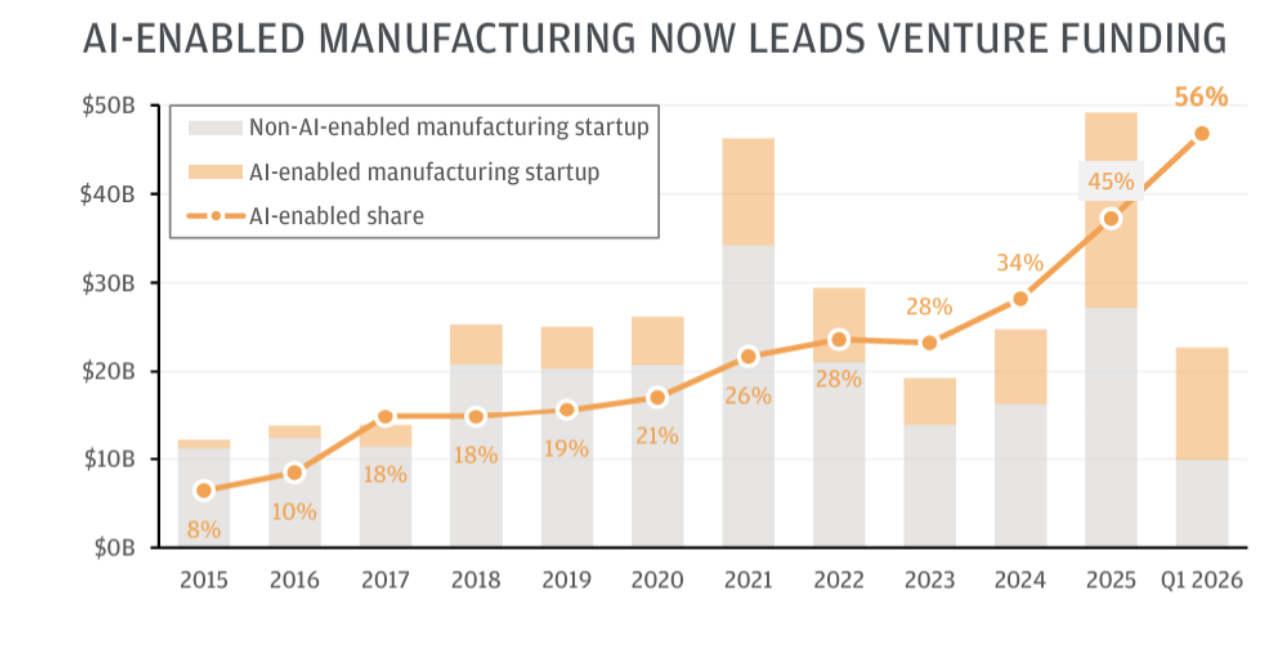
Venture funding tracked by J.P. Morgan across AI-enabled and non-AI-enabled manufacturing startups increased from approximately $25 billion in 2024 to $48 billion in 2025. In the first quarter of 2026 alone, approximately $23 billion was invested.
The share of that funding going to AI-enabled manufacturing companies has also risen rapidly:
34% in 2024,
45% in 2025,
56% in Q1 2026.
Where Does the Complexity Come From?
The first challenge lies in the data architecture. A single factory may contain machines installed in different periods and supplied by different manufacturers. Data may be fragmented across ERP, MES, SCADA and historian systems, maintenance software, and Excel files.
A significant portion of critical operational knowledge may not be recorded in any system at all. Instead, it often resides in the experience of field teams and machine operators.
Integration is equally complex. Which systems the product reads from, which systems it writes to, which actions it can perform automatically, and where human approval is required can vary significantly from one site to another.
A system operating in a production environment is expected to provide more than high accuracy. It must also offer traceability, auditability, human oversight, and clearly defined operational boundaries. These requirements create a significant gap between a product that works in a demo and one that can operate reliably in a real production environment.
As a result, Industrial AI has a longer, more complex, and more capital-intensive path between technical success and commercial success than many software categories.
The moat often begins to take shape while crossing this gap.
Technical complexity alone, however, is not a moat. A moat emerges when that complexity is converted over time into cumulative assets that competitors cannot efficiently replicate.
Where Does the Moat Accumulate?
Technical complexity in Industrial AI does not create a lasting competitive advantage on its own. The defensive layer becomes stronger when that complexity is converted over time into cumulative assets such as data, integrations, operational knowledge, and customer trust.
Proprietary Data
Machine behavior, failure histories, maintenance interventions, quality outcomes, and operator decisions can form valuable datasets over long periods of time. Much of this data only begins to emerge once a product is operating in real production environments.
As a product expands across more production environments, the company can accumulate greater operational context and learning, to the extent permitted by its data rights and product architecture. When that context improves product performance, the value delivered to customers also deepens. Over time, accumulated data and learning can make it more difficult for a new competitor to reach the same level of performance while also contributing to higher switching costs.
However, rights to access customer data, data ownership, and the ability to reuse that data across customers vary from company to company. The strength of a data-driven moat should therefore be evaluated not simply by the amount of data a company has, but by the combination of its exclusivity, scale, and lasting contribution to product performance.
Workflow Ownership
The advantage created by data becomes stronger as the product becomes embedded in the customer’s daily operations. Predicting the risk of a machine failure may be valuable on its own, but when that prediction is connected to maintenance planning, work-order processes, technician workflows, and spare-parts management, the product becomes a more central part of the operation.
At that point, replacing the product requires a more extensive transition. Integrations must be rebuilt, teams must adapt to a new system, and operational processes must be validated again. Products embedded this deeply into workflows can create stronger customer retention and higher switching costs.
Technical and Operational Context
Advances at the model layer make this dynamic even more important. As foundation models become more accessible and less expensive, differentiation based solely on model performance becomes harder to sustain.
In Industrial AI, durable value accumulates in operation-specific layers such as equipment knowledge, failure modes, process constraints, engineering logic, and validated integrations.
Declining model costs do not eliminate value; they change the layer at which value is created. Over time, competitive advantage can shift away from the model itself and toward the workflows and industry-specific operational context a company has built over years.
Operational Trust
Above all these layers sits operational trust.
Trust in industrial environments is built over time. A system may begin by monitoring and analyzing data, then progress to generating recommendations. As its performance is validated, it may be allowed to take controlled actions and gradually assume greater responsibility.
Each successful implementation increases the authority and trust the customer places in the system. Achieving similar model performance may eventually be possible, but replicating years of trust, integration history, and operational experience in a production environment is considerably harder.
For this reason, operational trust can become a powerful defensive layer, particularly in mission-critical production processes.
From an Investor’s Perspective
These dynamics require investors evaluating Industrial AI companies to look beyond model benchmarks. More important questions include how deeply the product is embedded in customer operations, whether increased usage generates proprietary data, and to what extent that data improves product performance.
The operational impact of the solution should also be measurable through metrics such as downtime, yield, scrap rates, production capacity, and energy consumption. The ability to make the second, tenth, and hundredth implementation easier than the first is a strong indicator of scalability.
How deeply integrations are embedded into the customer’s operations, and whether the same solution can scale with progressively less incremental labor as the company grows, are also important indicators of business-model quality.
One of the most meaningful questions for an investor is therefore:
By the 100th deployment, how much harder has the company become to replicate than it was at the first?
The strength of an Industrial AI company’s moat depends on how difficult it is for competitors to replicate the data, integrations, operational knowledge, and customer trust it has accumulated over time.
Defensive advantages in Industrial AI can emerge differently across product categories. Looking at real companies, these advantages tend to form around data, workflows, implementation experience, and physical systems.
Looking at these companies, the accumulation tends to take shape around data, workflows, implementation experience, and physical systems. With each new implementation, companies can accumulate more operational data, integration experience, and domain knowledge. Over time, this can become a defensive layer that is increasingly difficult for competitors to reproduce.
The Moat in Industrial AI
Long sales cycles, complex implementation processes, and significant integration requirements can initially slow the growth of Industrial AI companies. Hardware, field knowledge, and domain expertise also become natural parts of the product in many use cases.
At the same time, as AI models become more accessible and easier to substitute, long-term competitive advantage increasingly accumulates in the layers surrounding the model.
Each successful implementation brings new integrations and additional operational data. This data deepens the company’s operational context, contributes to better outcomes, and increases customer trust. Over time, the product becomes more deeply embedded in the customer’s operations.
The moat in Industrial AI is built from this accumulation: proprietary data, workflow ownership, technical and operational context, and operational trust.
The strongest companies in the category are likely to be those that accumulate more data and field knowledge with every new implementation, deepen their integrations, and become progressively more embedded in customer operations. This cumulative dynamic is also what makes Industrial AI particularly compelling from an investment perspective.