
Artificial Intelligence in Drug Discovery: Technological Advances and Economic Impact
Rising costs and longer clinical trial timelines are increasing the need for more efficient research methods across the biopharmaceutical (biotechnology and pharmaceutical) industry.
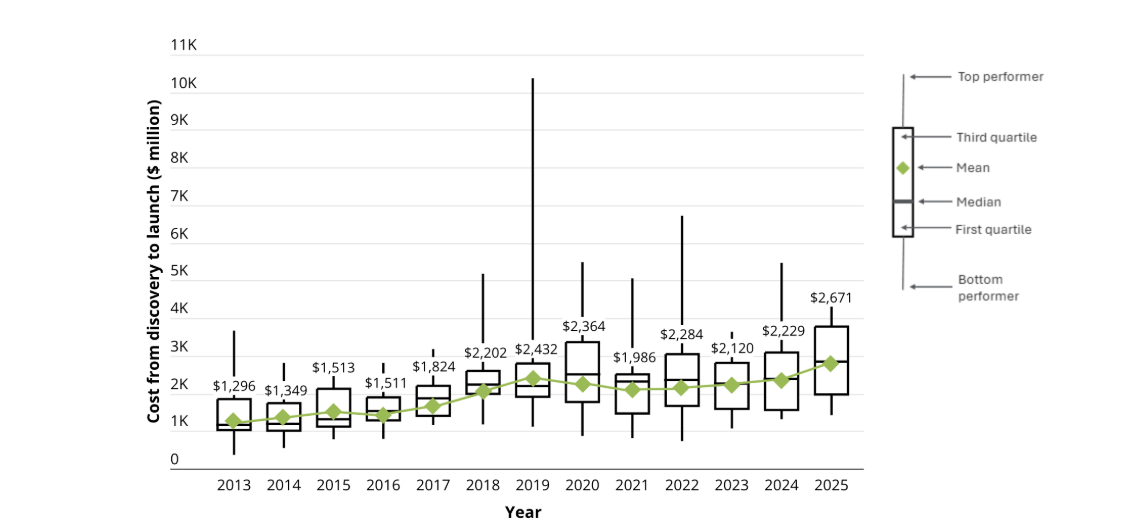
Rising costs and longer clinical trial timelines are increasing the need for more efficient research methods across the biopharmaceutical (biotechnology and pharmaceutical) industry. According to a 2026 Deloitte study covering 20 major biopharmaceutical companies operating globally, the average cost of developing a drug reached $2.67 billion in 2025. Against this backdrop, artificial intelligence is increasingly being used across stages ranging from the discovery of new medicines to the planning of clinical trials. Faster molecular design, early clinical findings and partnerships between major pharmaceutical companies and technology ventures are among the key signs of this shift.
Average company-level R&D cost from drug discovery to launch, 2013–2025
IQVIA Institute’s Global R&D Trends 2026 report, which examines R&D trends in the pharmaceutical industry, also indicates that clinical development timelines reached their highest level in a decade in 2025. Delays in patient recruitment and longer intervals between clinical trials contributed to this trend. Pressure on both costs and timelines is an important reason for the industry’s growing interest in AI.
Designing new drug molecules more quickly with AI represents a significant advance. However, turning this speed into lasting economic value depends not only on reducing research costs but also on whether it improves the likelihood of success as drugs progress through clinical development.
How Drug Discovery Methods Are Changing
According to IQVIA’s May 2026 analysis of Global R&D Trends 2026, which examines global pharmaceutical R&D trends, molecular discovery is the most common application of AI-enabled drug development programs. Most of these programs design new drug candidates against biological targets that are already known. Using AI to identify new targets associated with diseases remains less common, although it is an important area of scientific research.
Generative models can propose molecular structures with chemical properties that may suit a particular target. Other models predict how likely candidate molecules are to bind to a biological target or estimate specific properties, helping researchers prioritize which options to investigate in the laboratory. These methods do not eliminate the need for experiments; they help researchers decide where to focus their time and resources.
Predicting the three-dimensional structures of proteins is another important application. Developed by Google DeepMind, AlphaFold is an AI system designed to support structural studies that can take considerable time using conventional methods by predicting protein structures. It helps researchers assess disease-related proteins and potential drug targets. By 2025, AlphaFold had been used by more than three million researchers across over 190 countries, and its database contained more than 200 million predicted structures. Laboratory validation remains essential because these predictions cannot fully explain protein movement or every molecular interaction.
BioEmu, developed by Microsoft Research, is an AI system that models the different three-dimensional shapes proteins may adopt under varying conditions. According to a study published in Science in 2025 that directly examined BioEmu’s development and performance, the system can generate thousands of different protein conformations per hour on a single graphics processing unit. The BioEmu2 preview announced in October 2026 expanded this research toward modeling systems involving other biomolecules in addition to proteins.
Together, these technologies help researchers better understand biological targets and direct laboratory work toward more promising options.
Speed and Cost: Where Are the Gains Being Measured?
Insilico Medicine illustrates the speed gains AI can deliver in early-stage research. The company, which focuses on AI-enabled drug discovery, took approximately 18 months to progress from identifying a target to selecting a molecule suitable for preclinical development for rentosertib, a treatment being developed for a disease that causes progressive lung damage. Accelerating this stage, which can take several years using traditional approaches, is significant. It does not, however, establish that the total time required to test a drug in humans and secure approval has been reduced.
AI is also being used in clinical trials, where medicines are tested in people. In particular, it can help identify eligible patients and plan studies more efficiently. According to a 2026 survey of 200 senior executives conducted by Medidata, a company providing technology solutions for clinical research, approximately one-third of the organizations represented were actively using AI in clinical trials. Among respondents who had used AI for more than 18 months, 72.9% reported shorter study timelines.
AI is expected to reduce costs in the early stages of research, but these estimates do not represent savings already realized across the industry. Deloitte’s 2026 finding that average development costs reached $2.67 billion demonstrates the continued pressure on overall expenditure. Greater economic benefits depend not only on speeding up research but also on identifying projects more likely to fail at an earlier stage.
Clinical Success: Early Signals and Limitations
IQVIA’s May 2026 analysis reported a 75% Phase I success rate over the preceding three years among verified AI-enabled programs run by emerging biopharmaceutical companies. This is an encouraging signal compared with non-AI programs at companies of similar size. However, the two groups have shown comparable outcomes in Phase II, where drug efficacy is assessed more extensively. There are not yet enough comparable programs in Phase III to draw reliable conclusions. Given the small sample, these findings do not establish that clinical success rates have risen across the industry.
A broader review of the clinical progress of AI-enabled medicines was published in Cancer Treatment Reviews in October 2026. Examining data available through March 2026, the study assessed 129 AI-enabled drug development programs from 69 companies that had reached clinical testing. Only five of these programs had reached or completed Phase III, in which medicines are tested in larger patient populations. The findings show that AI-enabled drug development is progressing into clinical research.
Investment, Partnerships and Economic Returns
AI drug discovery ventures generate revenue through different approaches. Some provide research technology to pharmaceutical companies; others participate in joint development projects or develop their own medicines. These models differ in the timing of revenue, capital requirements and exposure to clinical risk:
Isomorphic Labs, which originated from Google DeepMind, is a prominent venture in this field. Its AI technology helps design new medicines by predicting how proteins and drug molecules may interact. The company announced $600 million in funding in March 2025 and another $2.1 billion in May 2026, bringing its total disclosed funding to $2.7 billion. It has research partnerships with major pharmaceutical companies including Novartis, Eli Lilly and Johnson & Johnson. These investments demonstrate commercial interest in the potential of its technology.
Major pharmaceutical companies are also expressing their interest in AI-enabled drug discovery through strategic partnerships. In March 2026, Eli Lilly, one of the world’s leading pharmaceutical manufacturers, signed an agreement with Insilico Medicine worth up to a potential $2.75 billion. The agreement aims to advance the research and commercialization of medicines developed with AI assistance. Beyond the initial $115 million payment to Insilico Medicine, further payments are contingent on achieving specified development and commercial milestones. The agreement reflects the growing interest of large pharmaceutical companies in AI-enabled research.
Deloitte’s 2026 review reported more than 40 AI-related agreements across pharmaceuticals, diagnostics and medical technology, with a combined disclosed potential value exceeding $30 billion. In the executive survey included in the same review, 71% of respondents reported progress in AI adoption, 45% reported measurable improvements and only 13% reported results at scale across their organizations. This gap highlights the importance of assessing investment and adoption alongside realized economic outcomes.
Reliability, Data Quality and Regulatory Developments
The competitive advantage of AI companies is not determined by model performance alone. Access to reliable biological data, laboratory validation, clinical expertise, intellectual property rights and the ability to work with major pharmaceutical companies are also important. Challenges around data infrastructure, model accuracy and integration with existing systems, highlighted in Medidata’s 2026 survey, demonstrate the need for continued investment in these areas.
Regulatory authorities are also working to support the responsible integration of AI into drug development. On January 14, 2026, the US Food and Drug Administration (FDA) and the European Medicines Agency (EMA) published ten shared principles for the use of AI in drug development. Covering areas such as data reliability, human oversight and regular evaluation of AI models, these principles provide a common approach to using the technology more systematically in research.
AI is accelerating the discovery of new medicines, improving research efficiency and strengthening collaboration between pharmaceutical companies and technology ventures. Progress across stages from molecular design to clinical research offers significant opportunities to make drug development more efficient and reduce research costs.
In the coming years, results from advanced clinical trials of AI-enabled medicines will allow a more comprehensive assessment of these technologies’ contribution to the pharmaceutical industry. If the speed gains achieved in research are supported by clinical success, AI’s potential to create sustainable economic value across the sector will become stronger.