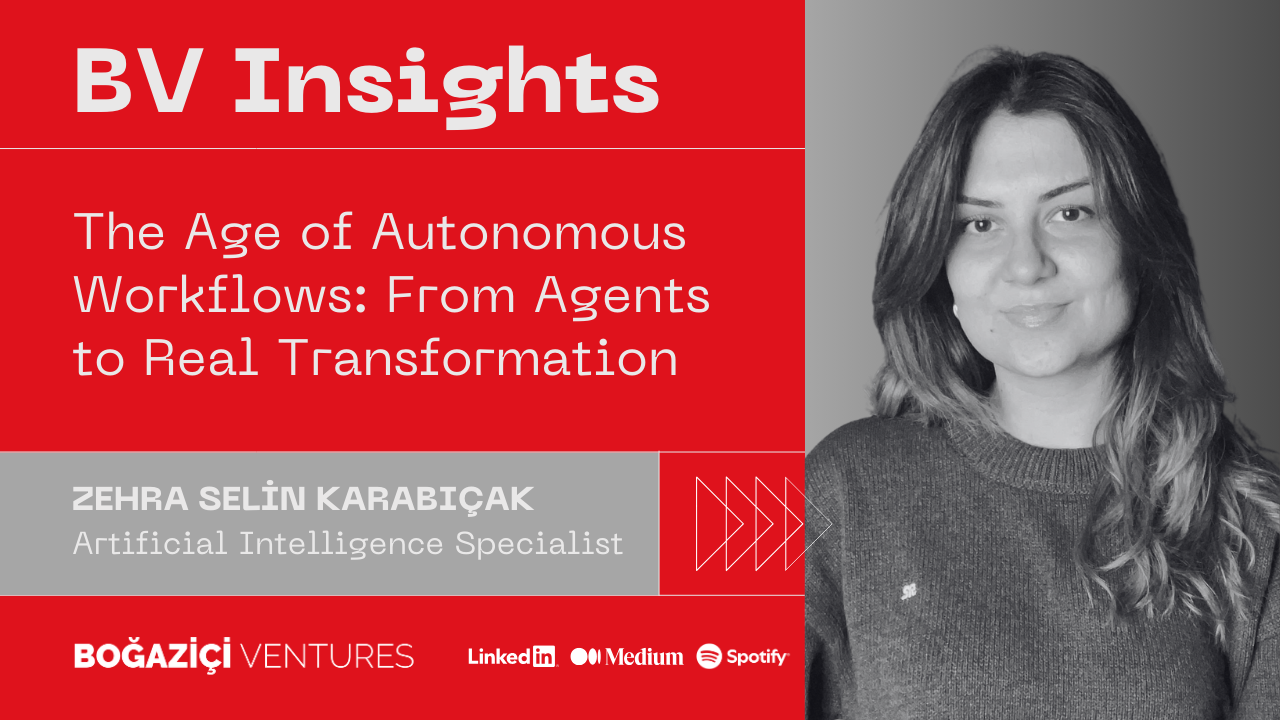
The Age of Autonomous Workflows: From Agents to Real Transformation
Hype, Reality, and the Window of Opportunity
While generative AI in the 2022–2023 period was largely limited to simple chat interfaces and text generation, by 2025 we have entered the world of autonomous agents—systems capable of organizing files, navigating across platforms, and taking direct action within enterprise systems such as ERP, CRM, and ticketing tools. The generative AI market is expected to approach USD 1 trillion by 2032 and, according to some analyses, exceed USD 1.3 trillion. Within this massive pool, the fastest-growing segment is autonomous agents and the workflow automation they enable.
Gartner predicts that more than 40% of agentic AI projects will be canceled by the end of 2027 due to rising costs, unclear business value, and weak risk management. At the same time, it is expected that by 2028 at least 15% of daily business decisions will be made autonomously, and nearly one-third of enterprise software will include agentic components. In other words, we are entering a transformation space where massive opportunity and significant “side-road” risk coexist. With our new fund, BV Growth II | Artificial Intelligence Fund, Boğaziçi Ventures is focused precisely on this intersection: in our view, the winners will not be those who merely “build agents,” but the teams that autonomously orchestrate workflows in a reliable, rational, and scalable way.
The “AI Everywhere” Wave in Enterprises
In the enterprise world, the vision of a single “super assistant” is giving way to agent mesh architectures—networks of agents embedded across different functions, operating like a web across data sources and applications. Gartner estimates that approximately 33% of enterprise software will include agentic AI components within the next few years. In banking, agent-based orchestration is redesigning not only credit scoring, but also end-to-end risk management, fraud detection, and compliance reporting. In retail, dynamic pricing, campaign automation, inventory optimization, and autonomous marketing operations are evolving into living systems that continuously adjust themselves based on demand signals. In manufacturing, end-to-end flows—from predictive maintenance to supply chain planning and shopfloor optimization—are becoming autonomous.
McKinsey emphasizes that the real value lies not in “one-off smart answers,” but in the end-to-end automation of recurring, complex workflows such as e-invoicing, policy renewals, demand forecasting, and incident detection. The challenge is no longer about building a good chatbot; it is about agents orchestrating the processes that make up an employee’s entire workday.
The Real Impact of Autonomous Workflows
Autonomous workflows are no longer just a new technology trend; they are a force redefining how work itself is done. McKinsey estimates that generative AI and agentic systems have the potential to create USD 2.6–4.4 trillion in additional annual value globally, with a significant portion of knowledge work falling within the scope of automation. This implies a shift in roles: instead of spending up to 60% of their day sorting emails, updating CRMs, or compiling reports, employees increasingly become “orchestra conductors”—designing, supervising, and handling exceptions in agent-driven workflows.
According to Accenture’s 2024 study, 74% of companies report that their generative AI + automation investments have met or exceeded expectations. The share of organizations with fully modernized, AI-led processes increased from 9% to 16% in just one year. Other studies show that over 80% of companies investing in automation and autonomous workflows allocate a recurring budget to this area, and around 65% of those that have implemented such investments report meaningful productivity gains.
The most visible transformation areas include call centers and customer service, e-commerce and logistics, financial operations, healthcare, HR, and IT support processes. Gartner predicts that by 2029, 80% of common customer service requests could be resolved by agentic AI without human intervention, potentially reducing operating costs by up to 30%. From the same perspective, by 2028 at least 15% of daily business decisions will be made by autonomous agents, and one-third of enterprise software will ship with agentic capabilities. This signals a new way of working—beyond the “AI assistant” wave—where core processes from order-to-cash, demand planning, and pricing are managed by an autonomous “operating system.”
Investment Climate and Türkiye’s Position
Globally, capital flows show no signs of slowing. In the first half of 2025 alone, AI investments reached USD 116.1 billion, already surpassing the total for all of 2024. Within total AI capital, the agentic / autonomous agents and AI agents market is estimated at USD 7–8 billion as of 2025. Various market research reports project this segment to grow to USD 50–200 billion between 2030 and 2034, corresponding to compound annual growth rates of 40–45%+. Both generative AI and its autonomous/agentic subsegment have become among the fastest-expanding pockets for investors.
Türkiye represents a young but rapidly growing laboratory in this landscape. The Turkish AI market is currently approaching the USD 1 billion range according to various sources, and is expected to reach approximately USD 7.3 billion by 2030, growing at an annual rate of 28–29% between 2024 and 2030. Driven by public initiatives, corporates, and funds, the number of AI-focused startups has multiplied in recent years. Today, we see hundreds of AI and agentic AI startups developing products across multiple verticals. Strong engineering talent, competitive cost structures, and the ability to test products in real-life scenarios at an early stage position Türkiye as an ideal pilot market and global launchpad for agentic AI applications.
Stories from the Portfolio
We experience this transformation firsthand through the startups in our portfolio.
Cerebrum Tech operates with digital humans/avatars on the front end, and dialogue, content, and decision agents on the back end. Positioned at the intersection of “AI + Digital Twin + Experience,” it gives autonomous workflows a human face and voice. Across sectors ranging from banking and public services to retail and education, Cerebrum Tech builds systems that automate citizen/patient/customer experiences end to end while keeping them human-centric—where chains of agents manage everything from identity verification and request classification to triggering relevant systems and collecting feedback.
Kalfa, on the other hand, transforms accounting and financial advisory processes from fragmented automation into an end-to-end autonomous workflow architecture. A document agent collects documents, a rules agent checks regulations and up-to-date legislation, and an audit agent detects anomalies and risks—working together as a coordinated system. While Kalfa is positioned today as a “co-pilot” for financial advisors, architecturally it offers full end-to-end autonomy for accounting processes: document collection, classification, bookkeeping, tax declaration preparation, and risky transaction detection all become part of a single agent-driven flow under human supervision.
The Boğaziçi Ventures Perspective
After reviewing hundreds of investment decks, the “agentic” label alone has never been sufficient for us. We evaluate startups through a three-layer filter: Architecture, Data/Domain, and Economics.
On the architecture side, we expect production-ready infrastructure—not demo hacks. This means built-in logging and security layers, including identity management, permission boundaries, monitoring, and rollback mechanisms. Agent actions must be auditable and traceable; the answer to “why was this decision made?” should be clearly visible in the logs.
On the data/domain dimension, we favor teams that go beyond using a good framework and instead have access to proprietary data or deep vertical expertise (Vertical AI). Anyone can build an agent framework; embedding it meaningfully into banking compliance processes, healthcare clinical operations, or shopfloor dynamics in manufacturing is far rarer—and where true differentiation lies.
From an economics standpoint, unit economics are critical. We support models where the cost per workflow is transparent, margins improve with scale, and customers see a clear ROI. We prioritize use cases that not only reduce costs but also unlock new revenue streams and grow total top-line value.
In this sense, Gartner’s “40% cancellation” warning is not a fear scenario for us; it is a healthy filter separating “agent washing” from genuine value creation. Looking ahead, Boğaziçi Ventures will continue to focus on teams that move beyond polished demos to fundamentally reshape how work is done through autonomous workflows—and can scale these models profitably. In this era where a new operating system for enterprises is being built beyond agents themselves, we believe that startups with the right architecture and the right economics will scale globally at remarkable speed.